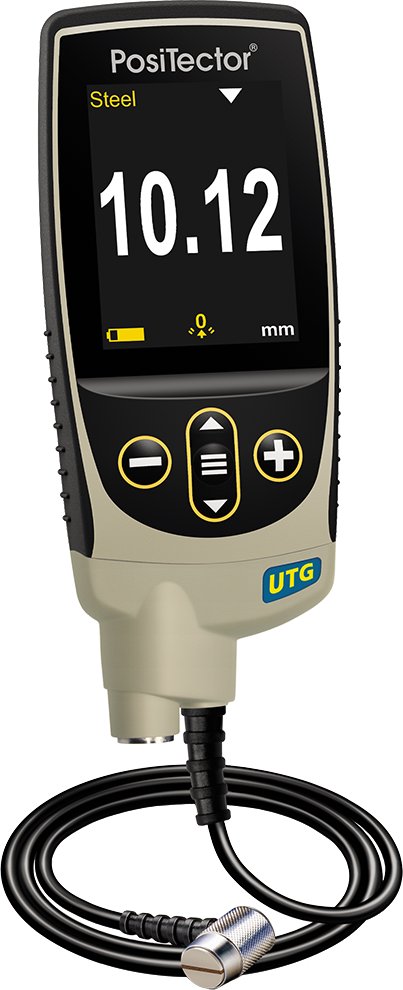
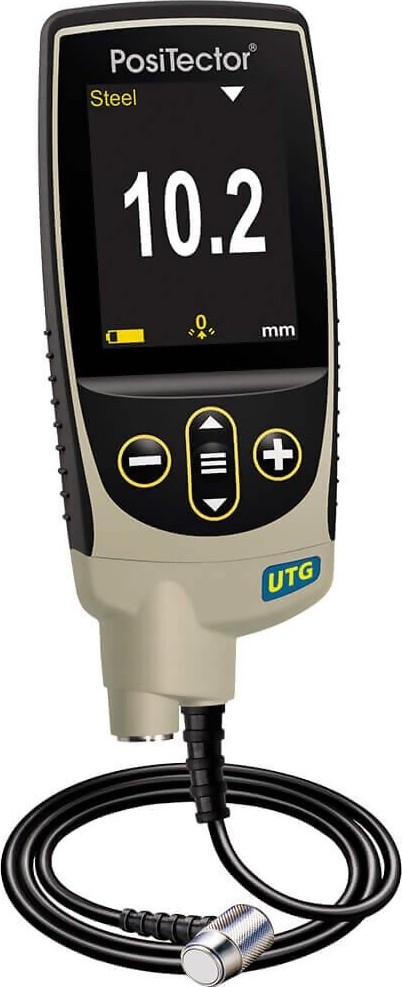
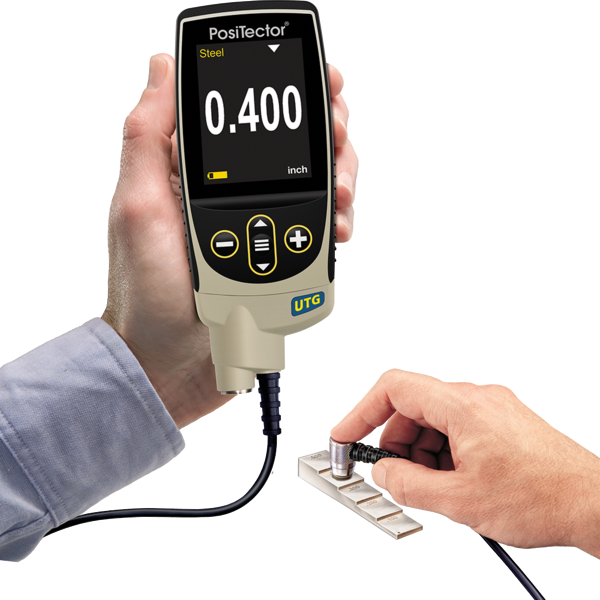
The DeFelsko KITUT1 PosiTector Standard Ultrasonic Inspection Kit is Wall Thickness and Corrosion Assessment. The DeFelsko KITUT1 PosiTector Standard Ultrasonic Inspection Kit include both the PosiTector UTG C Corrosion probe and the PosiTector UTG M Multiple-Echo probe, along with a choice of Standard Gage Body and a Certified Step Block—Inch. This combination provides a complete solution for measuring wall thickness on both heavily corroded and coated structures.
The DeFelsko PosiTector UTG C (Corrosion) probe uses a dual element transducer to measure metal thickness through heavy corrosion or pitting, while the PosiTector UTG M (Multiple-Echo) probe uses a single element transducer to measure the thickness of new or lightly corroded structures automatically ignoring protective coatings.
Kit Contents
- PosiTector Standard Gage Body BDYSTD
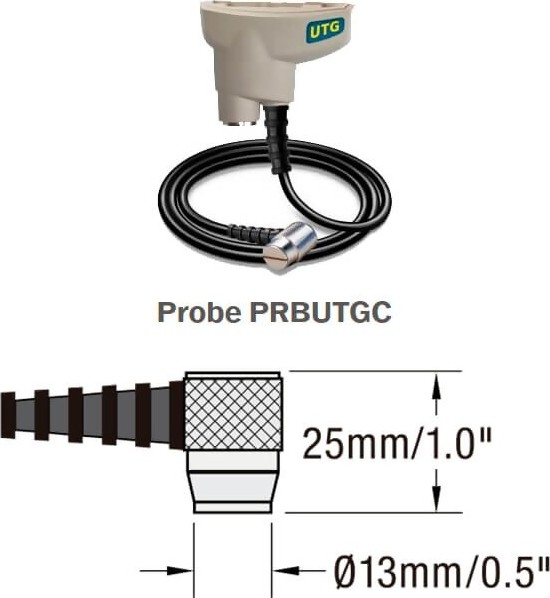
- PosiTector UTG C Probe PRBUTGC
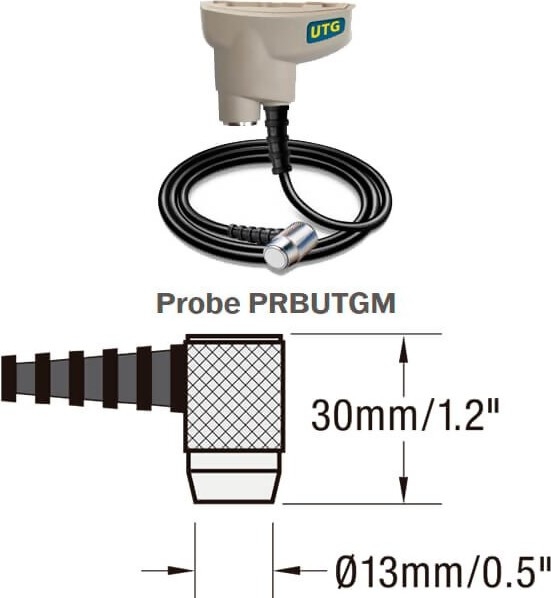
- PosiTector UTG M Probe PRBUTGM
- DeFelsko STDB1 Certified Step Block - Inch
- Couplant (Ultrasonic Gel)
- PosiSoft Software and USB Cable
- Protectiv Carrying Case and Instructions
- Two (2) Year Warranty
Features
Simple
- Pre-programmed velocities—simply select from a list of common materials or enter your own with ease
- Smart Couple™ mode eliminates unintentional decoupling—ensure continuous measurements while measuring on scaled or pitted surfaces—ideal for analyzing large areas using multiple passes
- NEW Larger 2.8" impact resistant color touchscreen with redesigned keypad for quick menu navigation
- NEW On-gage help explains menu items at the touch of a button
- RESET feature instantly restores factory settings
Durable
- NEW Weatherproof, dustproof, and water-resistant—IP65-rated enclosure
- NEW Ergonomic design with durable rubberized grip
- Shock-absorbing, protective rubber holster for added impact resistance
Accurate
- Precision ultrasonic transducers provide fast, accurate readings
- Certificate of Calibration (Long Form) showing traceability to NIST or PTB included
- Built-in temperature compensation ensures measurement accuracy
- Conforms to national and international standards including ASTM E797
Versatile
- PosiTector body accepts all PosiTector probes easily converting from an ultrasonic wall thickness gage to a coating thickness gage, surface profile gage, dew point meter, soluble salt tester, or hardness tester
- NEW Auto rotating display with Flip Lock
- Single or two point adjustment
- Inch/mm switchable
- Selectable display languages
- Extended cables available (up to 20 m/60 ft) for underwater or remote measuring
Powerful
- Min Scan mode—take continuous readings and record min/max thicknesses—ideal for quick inspection over a large area
- Statistics Mode continually displays/updates average, standard deviation, min/max, and number of readings while measuring
- NEW Screen Capture—save 100 screen images for record keeping and review
- NEW Instant-on feature quickly powers up the gage if recently powered down
- NEW Up to 30% longer battery life
- USB Port for fast, simple connection to a PC and to supply continuous power. USB cable included.
- PosiSoft USB Drive—stored readings and graphs can be accessed using universal PC/Mac web browsers or file explorers. No software required.
- Includes PosiSoft suite of software for reviewing and reporting data
- Every stored measurement is date and time stampe
Standard
- NEW Storage of 250,000 readings in up to 1,000 batches and sub-batchesaded
Probes
- DeFelsko PRBUTGC Probe measures the wall thickness of materials such as steel, plastic, and more
- DeFelsko PRBUTGC ideal for measuring the effects of corrosion or erosion on tanks, pipes, or any structure where access is limited to one side
- DeFelsko PRBUTGC 5 MHz dual element transducer with durable PEEK probe tip
- DeFelsko PRBUTGC automatic V-Path compensation for thin materials
- DeFelsko PRBUTGM Probe features Thru-Paint capability to quickly and accurately measure the metal thickness of a painted structure without having to remove the coating
- DeFelsko PRBUTGM also ideal for measuring applications requiring a more durable wear face
- DeFelsko PRBUTGM 5 MHz contact probe with wear resistant alumina probe tip
- DeFelsko PRBUTGM Multiple-Echo technique averages 3 or more echoes for accurate and reliable readings
Certified Step Blocks
- Ideal for checking calibration and operation of ultrasonic thickness gages and are an important component in fulfilling both ISO and in-house quality control requirements.
- Made from 1018 steel and nickel-plated for corrosion and wear resistance
- Long-form Certificate of Calibration and Material Test Report included
- STDB1 Certified Step Block—Inch
- 100, 200, 300, 400, and 500 mil steps
- Accuracy: ± 1 mil
- STDB1M Certified Step Block—Metric
- 2.5, 5, 7.5, 10, and 12.5 mm steps
- Accuracy: ± 0.025 mm
Specifications
| Probe Model | PRBUTGC |
| Type | 5 MHz Dual Element |
| Thru-Paint Capability (Multiple Echo) | No |
| Measurement Range - Single Echo* | 0.040” to 5.000”, 1.00 to 125.00 mm |
| Resolution | 0.001”, 0.01 mm |
| Accuracy | ±0.001”, ±0.03 mm |
| Probe Model | PRBUTGM |
| Type | 5 MHz Dual Contact |
| Thru-Paint Capability | Yes |
| Measurement Range - Single Echo* | 0.100” to 5.000”, 2.50 to 125.00 mm |
| Measurement Range - Multiple Echo* | 0.100” to 2.500”, 2.50 to 60.00 mm |
| Resolution | 0.001”, 0.01 mm |
| Accuracy | ±0.001”, ±0.03 mm |
*Measurement range is for carbon steel and depends upon surface condition, temperature, and material
PosiSoft Suite of Software
Related Products
DeFelsko Certified Step Blocks
Ideal for checking calibration and operation of ultrasonic thickness gages and are an important component in fulfilling both ISO and in-house quality control requirements.
DeFelsko Ultrasonic Couplant
Every PosiTector 200 and PosiTector UTG ships with (1) bottle of Ultrasonic couplant. Additional 4oz. bottles are available. (sold in case of 12 or twin packs).
Downloads
F.A.Q.
Do your instruments require any formal training for use? Do you offer ‘demo’ models?
No. Our instruments are designed for simple operation, feature easy-to-use menus, both full and quick instruction manuals, and helpful videos. In lieu of demonstration models, we provide unlimited technical support via telephone and/or email, and a limited 30-day money back guarantee.
Is the PosiTector UTG calibrated at the factory?
The PosiTector UTG arrives fully calibrated and ready to measure. A Long-Form Certificate of Calibration traceable to NIST is included, which documents actual readings taken by your instrument at our calibration laboratory on standards traceable to a national metrology institute. Beware of ‘Certificates’ or ‘Certificates of Conformance’ offered by competitors. These typically do not include actual instrument readings, and are often insufficient to meet common quality equirements.Verification of gage calibration and accuracy can be performed with the accessory Certified Step Block. If necessary, the PosiTector UTG operator can easily perform a calibration adjustment to align the gage’s thickness readings to match that of a known reference sample.
Can I measure the thickness of non-metallic materials like plastic and rubber with the PosiTector UTG?
Yes! The PosiTector UTG features several preprogrammed sound velocities for common materials. For best accuracy, make a simple adjustment to a known sample thickness of the material or quickly enter the material’s sound velocity into the gage. The PosiTector UTG C can be adjusted to a broad range of sound velocities spanning from 0.0492 to 0.393 mils/µs (1250 to 10000 m/s).
Can the PosiTector UTG measure cast/ductile iron or cast aluminum?
Our PosiTector UTG ultrasonic wall thickness instruments are designed to accurately measure the wall thickness of carbon steel, aluminum, stainless steel and plastic.PosiTector UTG probes utilize a 5MHz transducer. Like other UT (ultrasonic wall thickness) gages utilizing a 5MHz transducer, the PosiTector UTG is challenged to provide reliable wall thickness measurements on cast metals including iron, aluminum and zinc. The internal structure of the cast metal typically interferes with the transmission of a 5MHz sound impulse causing the gage to yield inaccurate thickness readings.
What is the difference between the PosiTector UTG C and PosiTector UTG M?
The PosiTector UTG C (Corrosion) single echo probe uses a dual-element transducer, a focused “V-path”, and V-path compensation to accurately measure the thickness of metals with particularly heavy corrosion or pitting. The UTG C single echo probe will not ignore the thickness of the exterior coating: for best measurement accuracy, it may be necessary to remove any coating present at the point of measurement.The PosiTector UTG M (Multi-echo) probe uses a single element transducer to accurately measure the metal thickness of a new or lightly corroded structure while ignoring the thickness of protective coatings. The ultrasonic beam travels in a straight path to the material’s back wall at 90° relative to the surface. When three consecutive back wall echoes are detected, the probe makes a time-based calculation to eliminate the coating thickness from the gage reading.
If there is paint on the surface and it can’t be removed, can the PosiTector UTG C be used?
Yes, but coatings such as paint have a slower sound velocity than metal. This means that coating ‘appears’ much thicker to the instrument than it actually is, and can substantially affect the reading. Using Thru-Paint technology, the PosiTector UTG M multi-echo probe disregards the exterior coating thickness on a painted metal structure and reports only the metal thickness.
Can the UTG measure the thickness of materials with heavy corrosion on the back/inside?
The PosiTector UTG C (Corrosion) is a proven solution for measuring the thickness of metal structures with pitting and/or moderate-to-severe corrosion on the back wall.
How often should the PosiTector probe be recalibrated?
PosiTector probes include a Certificate of Calibration with no expiry or end date. They have no shelf life, therefore the length of time in the field is not a good indicator for recalibration intervals. Many organizations with quality programs and recertification programs require annual recalibrations, and this is a good starting point for most users. Manufacturers recommend that customers establish calibration intervals based upon their own experience and work environment. Based on our product knowledge, data and customer feedback, a one year calibration interval from the date the instrument was placed in service is a good starting point.