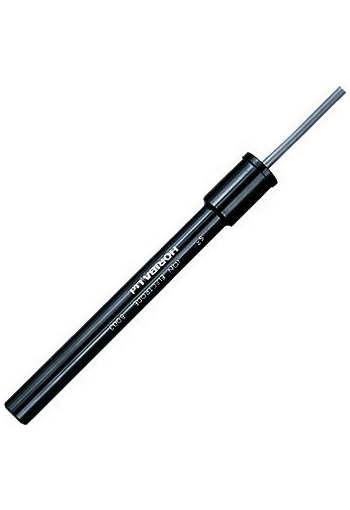
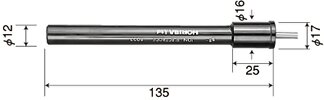
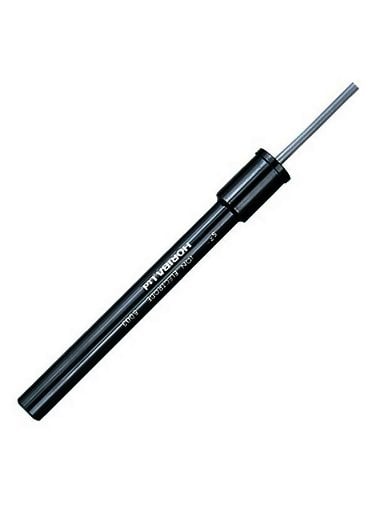
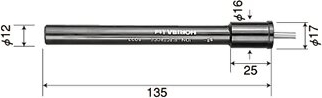
Horiba Laqua 8003-10C Sulfide Ion Electrode, # 3014094395
Measuring range: 0.32 to 32,000 mg/L S
2- | (10
-5 to 1 mol/L) S
2-
pH Range: 3.2 mg/L (10
-4 mol/L) S
2 | pH 12 to 14
Applicable temperature range: 0 to 50ºC
The Horiba Laqua 8003-10C Sulfide Ion Electrode, # 3014094395 is an Ion Selective Electrode - the reference electrode and ion sensing electrode are built in one body.
HORIBA's superior electrode technology has produced unparalleled tough pH glass bulbs and unique flat sensors. Electrodes have different designs to cater a wide range of applications - from pure water to complex samples.
Specifications
Measuring range | 0.32 to 32,000 mg/L S2-
(10-5 to 1 mol/L) S2- |
pH range | 3.2 mg/L (10-4 mol/L) S2-
pH 12 to 14 |
Applicable temperature range | 0 to 50ºC |
Response time (90%) | Within 10 seconds |
Applicable reference electrode | 2060A,
2565A |
Selection coefficient | CN- = Not acceptable
S2O32- = 10
l-、F-、Cl-、PO42-、SO42- = 1,000 |
The response time is the time which is required to reach 90% response when the ion concentration is gradually changed from 10-4 mol/L to 10-2 mol/L with the solution stirred. Exception:- *1: 90% response when ion concentration is changed to 10-6 mol/L ∼ 10-2 mol/L
- *2: 95% response when ion concentration is changed to 10-3 mol/L ∼ 10-1 mol/L
- *3: 95% response when ion concentration is changed to 10-4 mol/L ∼ 10-2 mol/L
- *4: 95% response when ion concentration is changed to 10-4 mol/L ∼ 10-1 mol/L
The selection coefficient is a ratio of the limit concentration of coexisting ions (mol/L) to the ion concentration to be measured (mol/L); The value of 1000 means that the coexisting ions can be permitted up to 1000 times the ion measured and ''not acceptable'' means that chemical change occurs in the solid response membrane.
Downloads