$3,237.00 - $3,283.00
    warranty 1 year
    Product Description

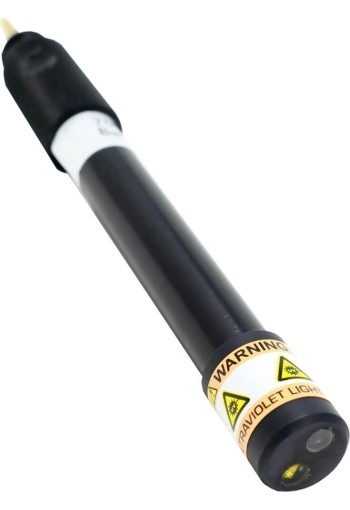
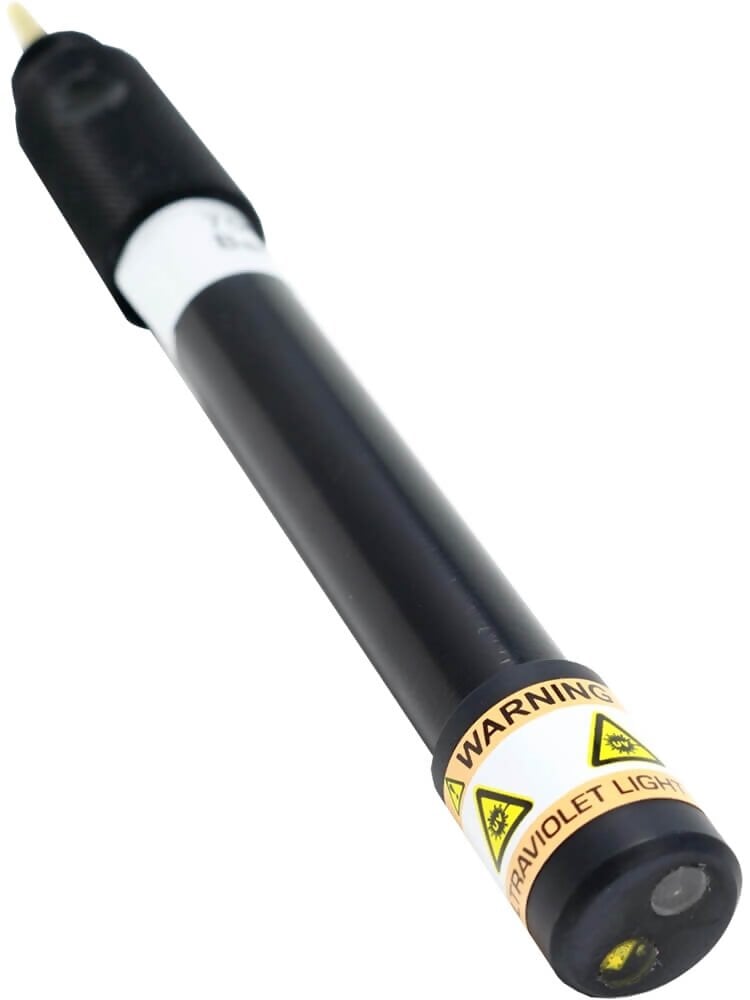
    The is for accurate CDOM/FDOM monitoring, try using our CDOM sensor with the Aquaprobe. This sensor is fixed response fluorometer, which provides excitation at 365nm (UV) and detects any resultant fluorescence between 450nm and 520nm.

    What CDOM is and How to Monitor its Levels in Water
    • Coloured, or chromophoric dissolved organic matter (CDOM), is a naturally occurring dissolved matter that absorbs UV light in water. It’s usually made up of tannins that are released from the breakdown of plant material.
    • A fraction of CDOM fluoresces when it absorbs light of a certain spectrum, and is called fluorescent dissolved organic matter, or FDOM.
    Simple installation
    • Installing the CDOM sensor into an Aquaprobe is a very simple process. Simply unscrew the blanking plug from an appropriate aux socket, apply some silicon grease to the thread of the sensor (grease provided), and screw in the sensor. Full calibration is required after installation.
    Simple calibration
    • A core aim at Aquaread is to make our products easy to use, which is why we have simplified and automated the calibration process as much as possible. The CDOM sensor is calibrated at 2 points. A zero point and a 100µg/l point using Aquaread’s CDOM-CAL solution.
    Grab sample fator
    • When taking measurements at a particular site there can occasionally be a difference between measured values with the sensor and laboratory data. These differences are caused by a variety of factors.
    • You can apply a multiplier to the data obtained from our sensor in order to make it more closely correlate with lab data for that particular site. To do this we use a grab sample factor. This factor can be calculated by dividing the average grab sample value (measured in the lab) by the average value measured by our CDOM sensor.
    • This is a great addition to the software when trying to correlate new data with historic readings from the same site.
    Limitations
    • Determination of CDOM in the field using fluorescence measurement techniques will never be as accurate as measurements made in a lab using traditional techniques.
    • Factors adversely affecting accuracy include:
      • Interference from compounds which fluoresce at similar wavelengths
      • Differences in the fluorescent response caused by temperature
      • Differences in the fluorescent response caused by ambient light
      • Interference caused by turbidity
    • Fluorescence measurement techniques are ideal for researchers who are interested in detecting the presence or absence of a specific substance and measuring relative fluorescence changes that can be used as an indication of increasing or decreasing concentrations.
    • Fluorescence measurement techniques are not ideal for quantitative measurement. In order to obtain more accurate results, data obtained with the fluorometer in the field should be post-calibrated with data from standard laboratory analysis of grab samples acquired during the study.
    • If grab sample data is available, a Grab Sample Factor (GS Factor) should be calculated and input on the calibration screen in order to improve the accuracy of future readings.

    Features
    • Dense sapphire lenses are used on our CDOM sensor for their high clarity and scratch resistance
    • Specialised deep UV LED is used to excite the fluorescent dissolved organic matter
    • Measurement range 0 – 2,000mg/l
    • Resolution: two auto ranging scales 0.00 – 99.9mg/l, 100.0 – 2000mg/l
    • Repeatability: +/- 10% of reading or 2ppm (whichever is greater)
    • Simple to install on a wide range of Aquaprobes
    • Easy 2-point calibration
    • Site specific calibration with grab sample calibration option
    Related Product

    NKE Aquaprobe-2000 Water Monitoring Probe


    The NKE Aquaprobe-2000 Water Monitoring Probe is the smaller of our advanced portable multiparameter water monitoring probes. It comes with a range of standard sensors included, it also offers some customisation options that allow you to add even more sensors to the probe. All of our probes are constructed from tough marine grade aluminium that has been hard anodised, making it suitable for use in both fresh and salt waters

    Click image for more info

    NKE Aquaprobe-5000 Water Monitoring Probe


    The NKE Aquaprobe-5000 Water Monitoring Probe is the larger of our advanced portable multiparameter water monitoring probes. It comes with a range of standard sensors included, and much like its smaller counterpart it offers more customisation options that allow you to add extra sensors to the probe. All of our probes are constructed from tough marine grade aluminium that has been hard anodised, making it suitable for use in both fresh and salt waters.

    Click image for more info

    NKE Aquaprobe-7000 Water Monitoring Probe


    The NKE Aquaprobe-7000 Water Monitoring Probe is designed for long term deployment utilising a central cleaning system to keep the fitted sensors clean reducing the effects of bio-fouling common in extended deployments. The probe comes with all of our standard parameters including optical dissolved oxygen, it also features 6 user configurable auxiliary sockets allowing you to add multiple specialist sensors to the probe. The NKE Aquaprobe-7000 Water Monitoring Probe is capable of measuring up to 17 individual parameters at once.

    Click image for more info

    NKE Aquaprobe-6000 Water Monitoring Probe


    The NKE Aquaprobe-6000 Water Monitoring Probe can be used for comprehensive spot monitoring as part of a package or it can be used in permanent deployments thanks to its new, much smaller self cleaning mechanism. It features a diameter of only 58mm (the same size as the AP-5000) making it our smallest self cleaning Aquaprobe to date.

    Click image for more info
    Downloads

    F.A.Q.


    More on CDOM testing CDOM/FDOM

    The testing CDOM/FDOM is used to measure the relative amount of dissolved organic material (DOM) in the water. Although it is naturally occurring, human influence through aspects such as logging, agriculture, effluent discharge, and wetland drainage can affect the levels of CDOM in freshwater and estuarine systems.

    How to use a CDOM sensor

    A CDOM sensor works by sending a light beam into the water to be tested, at a fixed wavelength. This wavelength of light excites the matter which subsequently fluoresces at a known wavelength band. The level of excitation measured is proportional to the amount of CDOM present in the water.

    To use Aquaread's CDOM sensor, first install it into your probe of choice, then perform a full calibration using CDOM-CAL solution from Aquaread. Once calibrated it's good to go. Simply put the probe into the body of water, allow the reading to stabilise, and take your measurement.

    If you record a difference in chlorophyll levels vs a lab test at the same site, you can use the lab data to apply an offset, fine tuning the probe to detect correctly at that particular site.

    When to use a CDOM sensor

    It is vital to measure the levels of CDOM/FDOM and understand their trends because they can have a significant effect on aquatic ecosystems. Raised levels of CDOM/FDOM can inhibit the growth of phytoplankton and limit photosynthesis, damaging the food chain and limiting the production of oxygen in water bodies.

    Copyright © 2026 Abq Industrial