$897.00 - $910.00
    warranty 1 year
    Product Description

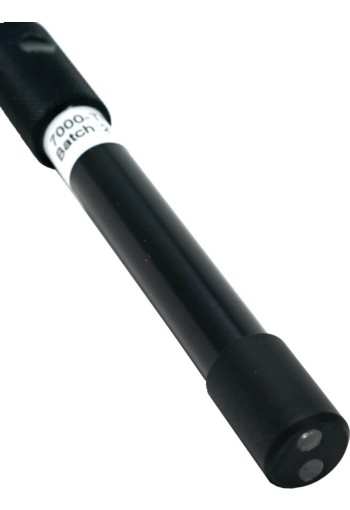
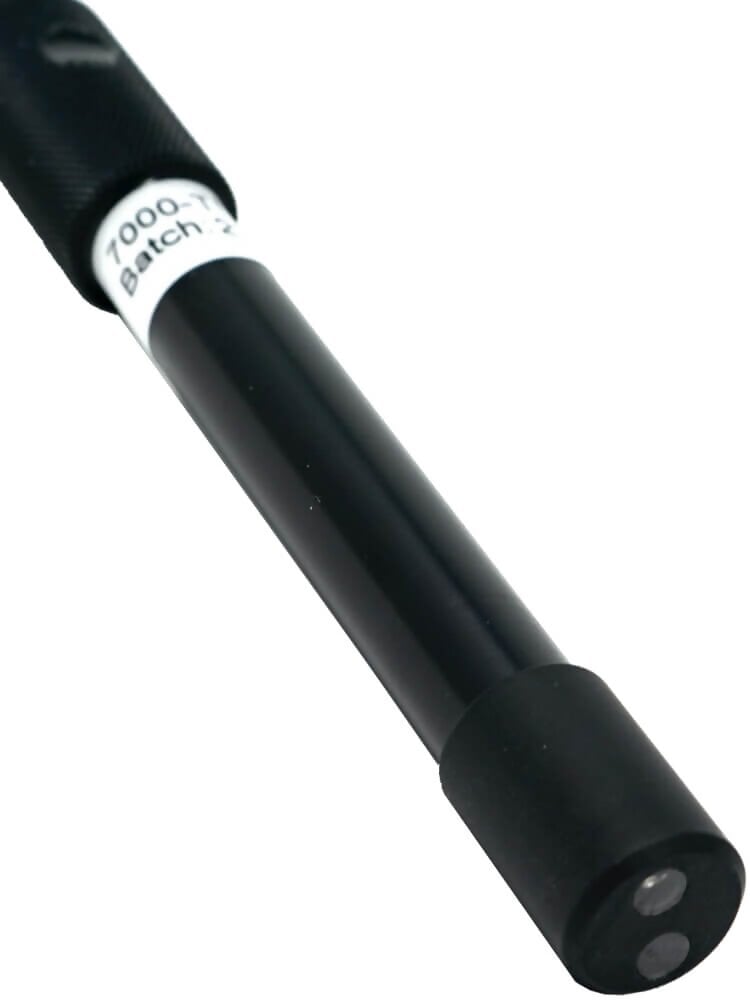
    The NKE Sensor TURB Aquaread Turbidity Optical Electrode is designed to give a measure of suspended particles in a sample of water. It achieves this by emitting infra-red light into the sample and measuring the incident light scattered at right angles from the particles in the sample.
    This electrode employs a Nephelometric technique in accordance with ISO 7027, which uses Formazin as a reference standard. The Aquameter displays turbidity in Nephelometric Turbidity Units (NTU) which are nominally equivalent to Formazin Turbidity Units (FTU).
    Turbidity is a measurement of solid matter being suspended in water, rather than dissolved into it. If water is turbid it appears to be cloudy, so is a visual guide to water quality.

    Versatile sensor
    • The turbidity sensor can be used in the AP-LITE for a single parameter setup, where turbidity measurement is the only requirement. The sensor can also be used in all of our multiparameter Aquaprobes and Aquasondes where larger data acquisition is required.
    Cost-effective solution with high performance
    • The turbidity sensor is designed and manufactured by Aquaread in the UK. We take every care to ensure the highest quality at an industry-leading price point.
    Simple installation
    • Installing the turbidity sensor into an Aquaprobe is a very simple process. Simply unscrew the blanking plug from an appropriate aux socket, apply some silicon grease to the thread of the turbidity sensor (grease provided), and screw in the sensor. Full calibration is required after installation.
    Simple calibration
    • Here at Aquaread, ease of use factors into each and every one of our products. This ethos extends to the calibration process.
    • Basic calibration for the sensor involves calibrating at both 0NTU and 1000NTU. Simply put the probe into the desired solution, select the correct calibration point from the calibration menu, and press OK. The Aquameter will do the rest, checking it’s in the correct solution and checking for stability prior to completing the calibration.
    • If your application requires high accuracy at the low end of the measurement scale, a 20NTU calibration point is also available.

    Features
    • Dense sapphire lenses are used on our turbidity sensor for their high clarity and scratch resistance
    • Turbidity Measurement range: 0-4000 NTU
    • 3-point calibration at 0, 20 and 1000NTU
    • Internal temperature compensation
    • Auto range scaling: 0-99.9 / 100-4000 NTU
    • Simple to install on a wide range of Aquaprobes
    • Easy calibration
    Related Product

    NKE Aquaprobe-2000 Water Monitoring Probe


    The NKE Aquaprobe-2000 Water Monitoring Probe is the smaller of our advanced portable multiparameter water monitoring probes. It comes with a range of standard sensors included, it also offers some customisation options that allow you to add even more sensors to the probe. All of our probes are constructed from tough marine grade aluminium that has been hard anodised, making it suitable for use in both fresh and salt waters

    Click image for more info

    NKE Aquaprobe-5000 Water Monitoring Probe


    The NKE Aquaprobe-5000 Water Monitoring Probe is the larger of our advanced portable multiparameter water monitoring probes. It comes with a range of standard sensors included, and much like its smaller counterpart it offers more customisation options that allow you to add extra sensors to the probe. All of our probes are constructed from tough marine grade aluminium that has been hard anodised, making it suitable for use in both fresh and salt waters.

    Click image for more info

    NKE Aquaprobe-7000 Water Monitoring Probe


    The NKE Aquaprobe-7000 Water Monitoring Probe is designed for long term deployment utilising a central cleaning system to keep the fitted sensors clean reducing the effects of bio-fouling common in extended deployments. The probe comes with all of our standard parameters including optical dissolved oxygen, it also features 6 user configurable auxiliary sockets allowing you to add multiple specialist sensors to the probe. The NKE Aquaprobe-7000 Water Monitoring Probe is capable of measuring up to 17 individual parameters at once.

    Click image for more info

    NKE Aquaprobe-6000 Water Monitoring Probe


    The NKE Aquaprobe-6000 Water Monitoring Probe can be used for comprehensive spot monitoring as part of a package or it can be used in permanent deployments thanks to its new, much smaller self cleaning mechanism. It features a diameter of only 58mm (the same size as the AP-5000) making it our smallest self cleaning Aquaprobe to date.

    Click image for more info
    Downloads

    F.A.Q.


    More on Turbidity testing

    Turbidity water testing is an important part of water quality maintenance. Increased levels of turbidity raises water temperatures, because heat is absorbed by the suspended particles. Warm water holds less dissolved oxygen than cold, so increased water temperatures result in decreased levels of dissolved oxygen.

    Higher turbidity also reduces the amount of light that can penetrate the water, therefore reducing photosynthesis and the production of dissolved oxygen. Higher turbidity can have a negative effect on the ecosystem in the affected body of water.

    Sudden changes in turbidity may be an indication of the emergence of a new pollution source, or with drinking water there may be an issue in the treatment process.

    How the turbidity sensor works

    A turbidimeter works by sending a light beam into the water to be tested. This light will then be scattered by any suspended particles. A light detector is placed at a 90 degree angle to the light source, and detects the amount of light that is reflected back at it. The amount of light reflected is used to determine the particle density within the water. The more light that is detected, the more particles are present in the water.

    To use Aquaread's turbidity sensor, first install it into your probe of choice, then perform a full calibration of the 0 and 1000NTU calibration point. Once calibrated it's good to go. Simply put the probe into the body of water, allow the reading to stabilise and take your measurement.

    When to use the sensor

    Turbidity is a very common water quality parameter because its easy to measure and because it can have such a big effect on the ecosystems present in the water. Turbidity monitoring is particularly important if large scale building works are being carried out close to an open water way. It is very common in this situation to monitor turbidity for a period of a few weeks prior to building works commence, in order to characterise a baseline turbidity level and usual fluctuation caused by rainfall etc.

    The monitoring should then continue during the building work and for a few weeks after its complete. Data collected from this kind of study can be provided to the Environment Agency to prove that your building works have not adversely affected the nearby water system.

    Copyright © 2026 Abq Industrial